
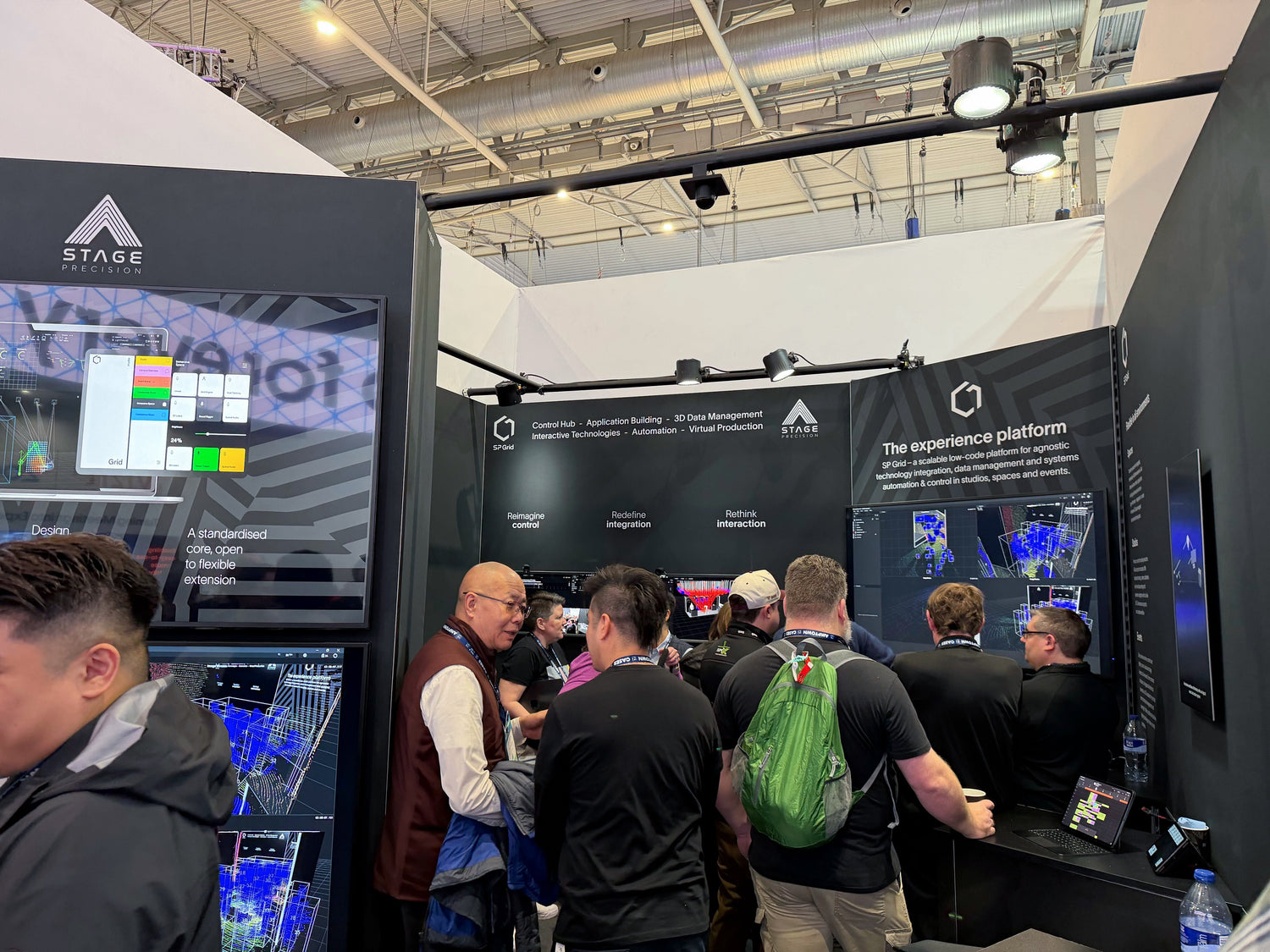
We are heading to NAB 2026, with some major announcements and software releases. Grid Studio 2.1 launches with redesigned camera calibration workflows, delivering a 16x faster process. Intelligent spatial sensing through new Grid Extensions, and the release of Grid Recorder, a new capture and replay software that eliminates repeat studio time for calibration, rehearsal, and pipeline testing.
Anyone who has calibrated a virtual production stage knows the challenges. Static camera positions, manual capture triggers, careful zoom management, and the constant risk of someone accidentally touching a lens ring or not getting full lock off on camera jibs and invalidating a pass. Grid Studio 2.1 eliminates that entire margin of error in the process.
The new automated calibration engine monitors and analyses tracking data continuously once the process has been initiated. This new workflow replaces the requirement to hold the camera still, navigate to specific zoom steps, or press a capture button. The engineer starts the process and simply moves through the space, and the system does the work. Calibration becomes a fluid and natural workflow, not a stop-and-start procedure.
"Calibration used to require multiple steps. Now it happens 16x faster and in one seamless process." Axel Lambrecht, CXO.
Grid Studio 2.1 also introduces a new approach to lens modelling. Rather than collecting measurements at fixed positions and interpolating between them, the system builds a predictive model of how a lens actually behaves across its full range. Even a sparse calibration delivers reliable results across the entire zoom and focus range. Operators can zoom and adjust focus freely while moving; the system captures the lens profile alongside spatial calibration in a single continuous pass. Higher distortion resolution means the profiles are also compatible with other lens model formats.
The result: lens calibration, tracking alignment, and spatial wall calibration now happen simultaneously rather than as separate sequential stages.
For LED walls, Grid Studio 2.1 introduces a spatial topology model. The system now understands that panels in a wall are structurally connected, so it can infer the position of panels it has not directly seen from the positions of their neighbours. This directly addresses a persistent real-world pain point: minute variations in panel installation, complex curved configurations, and the surface mesh gaps that cause set extension feathering artefacts in media server platforms. This new topology results in an accurate and connected screen mesh, exportable for use in other media servers as a modelled surface.
A redesigned calibration interface completes the picture. As calibration progresses, calibration screen feedback appears in the 3D viewport in real time with colour-coded status indicators. Camera positions are shown as preview markers in space. The state of the calibration is visible at every moment to guide the calibration engineer, without waiting for a full pass to complete.
Grid Extensions: New Partners to the Ecosystem
Virtual production and broadcast workflows increasingly require data from multiple specialised systems to be available in one place. Grid Extensions is Stage Precision's answer: a structured integration framework that brings third-party connections directly into the Grid Platform, all managed through the same unified environment in the Grid Studio software.
At NAB 2026, Stage Precision will demonstrate a full studio set-up in partnership with Pixera, showcasing multiple Grid Extensions representing a broad cross-section of the signals and technology that integrate into SP Grid and drive modern VP and broadcast studio workflows.
Pixera: Media Server Timeline and Content Control
The Pixera Grid Extension, which connects to Pixera media servers at the timeline, layer and parameter level, gives studio operators total control.
Once connected, Grid Studio can access and control the key components of real production workflows, including timelines, cues, blending, opacity, playback speed, transport mode, and cue navigation. That means operators can trigger content changes with precision, automate transitions based on events or schedules, and unify playback control alongside camera-tracking calibration workflows, sensor inputs and interactive triggers. SP Grid can also set screen position and rotation within Pixera, and reset or reposition calibration markers, making it possible to manage Pixera's spatial configuration and media controls from within the same show control environment that manages the studio environments' tracking, camera and wall calibration.
Stage Precision x AV Stumpfl: SP Lens Playback in PIXERA
Stage Precision and AV Stumpfl partnered in Summer 2025 to deliver camera calibration playback natively within PIXERA media servers, bringing SP calibration tools, workflows and accuracy to ICVFX virtual production without conversion steps in the way.
With an SP Lens Playback license added to a PIXERA license, productions can create detailed lens profiles and camera alignment files natively in Grid Studio, export them in their native format, and load them directly into PIXERA to host the calibration file locally. No conversions required.
The workflow supports two distinct data sets generated from SP software. A Lens Profile captures intrinsic photometric data across the full zoom and focus range of a camera. A Camera Alignment is a calibrated data set that repositions a tracking system in relation to a screen source in the physical world. Both can be created in SP and played back in PIXERA as part of a unified production pipeline.
SP Lens Playback is available now as an addition to your PIXERA license. Speak with the Stage Precision team at NAB to integrate this into your virtual production pipeline.
AR-51: Markerless Skeleton Tracking
We welcome AR-51 to our Extension library. AR-51's AI-powered markerless motion capture system delivers real-time skeleton data at 9ms latency, capturing an unlimited number of “talent” in any scale of space without suits or wearables. The AR-51 Grid Extension brings this data into SP Grid as a live structured feed.
What makes this particularly powerful for broadcast and VP environments is AR-51's ability to learn and recognise specific individuals. The system can easily register known people by appearance, assigning a persistent ID per person, meaning SP Grid can trigger workflows not just based on where someone is in the space, but based on who they are. Camera moves, lighting states, content triggers, and zone-based events, all managed within Grid Studio, can all be tied to a specific presenter or talent with no hardware on their person at any point.
AR-51 skeleton data becomes a direct control source across the entire studio workflow, driving automated lighting responses that follow presenters in real time, controlling PTZ camera positioning based on where talent actually is in the space, and triggering content events through configurable zones defined within Grid Studio. When a recognised individual enters, leaves, or dwells within a defined area, Grid Studio handles all the logic and workflow responses automatically. For broadcast studios, the combination of markerless identification at 9ms latency and zone-based automation in Grid Studio represents a meaningful step change in what a production team can deliver without any specialist infrastructure on talent.
Megapixel Helios: LED Processor Control and Monitoring
The Megapixel Helios Grid Extension brings full bidirectional control of Megapixel LED processors. Display parameters, input selection, genlock, latency, and redundancy settings are all accessible as SP Grid actions. Real-time monitoring surfaces fan, temperature, voltage, and alert data without leaving the SP Grid environment.
GhostFrame support: Full per-slice gain, tracking configuration, and chroma track colour control, giving VP studios running Megapixel's GhostFrame workflow direct control from within SP Grid.
RoboSense Airy: 3D LiDAR Spatial Sensing
The Robosense Grid Extension brings live point cloud data directly into Grid Studio, enabling real-time spatial awareness of any monitored volume. People, objects, and movement are captured continuously without markers or wearables.
Zone-based spatial logic configurable in Grid Studio, triggers events based on point cloud activity. Entries, exits, dwell, and movement between areas. No physical infrastructure beyond the sensor. No bespoke pipeline required.
"SP Grid is the intelligence layer. Grid Extensions bring every connection in the studio to the same place."
OpenTrackIO: Open Standards from SMPTE RIS OSVP
We are also announcing native OpenTrackIO support as a new Grid Extension, bringing the SMPTE RIS OSVP open tracking standard directly into Grid Studio.
OpenTrackIO establishes a common language for camera tracking and lens metadata across virtual production pipelines, enabling any compliant tracking source to communicate with any compliant system without proprietary translation layers. By supporting OpenTrackIO natively within Grid Extensions, this builds on our agnostic position in open VP ecosystems, receiving standardised tracking and lens data from any compliant source and making it available within the wider workflow.
Grid Recorder: Record Once. Replay Anytime.
Grid Recorder is an independent application for capturing and replaying camera tracking and metadata pipelines. It records raw UDP streams byte-for-byte alongside synchronised SDI video, preserving the exact relationship between image and data down to the millisecond. Replay sessions behave indistinguishably from a live feed, with no protocol decoding, no middleware, and no dependencies on the systems that originally generated the data.
Because Grid Recorder captures at the UDP transport layer rather than decoding vendor formats, it works across any tracking or metadata pipeline without being tied to a single ecosystem. Any protocol that travels over UDP can be recorded and replayed. The same session that ran on a live stage can be replayed indefinitely on a workstation, a calibration rig, or a content system, wherever it is needed.
The practical outcome is significant: studios record a tracking and video session once, then replay it on demand to run lens calibrations, validate content, and test pipeline changes. Valuable studio time, live operators, and fully loaded systems are reserved for the work that actually requires them.
“Studio workflows have been at the heart of SP for many years. What Grid Studio 2.1 represents is everything our studio users already trust, taken considerably further. Smarter calibration, deeper integrations, and agnostic tools that directly reduce the cost and complexity of running a modern VP or broadcast pipeline. This is a focused evolution, built on years of real production experience. We are excited to showcase this release at NAB" - Sarah Cox, CCO.
Availability
Grid Studio 2.1 is available from NAB as a free download, with Credits to removed datawatermarks from connections. Grid Extensions for AR-51, Megapixel Helios, Pixera, OpenTrackIO and RoboSense Airy are available through the Grid Extensions library in Grid Studio. Grid Recorder is launching at NAB Show 2026 as 1 month rental or perpetual license options.
Stage Precision will partner with Pixera in a joint booth, demonstrating the full suite of Grid Studio 2.1 features, Grid Extensions, and Grid Recorder at NAB Show 2026. Visit us at C1824 or speak with the team to discuss integration into your studio pipeline.