
Munich, Germany // 2025
WBLT harnesses SP to bring unique interactivity to the pitch for DAZN Infinity League
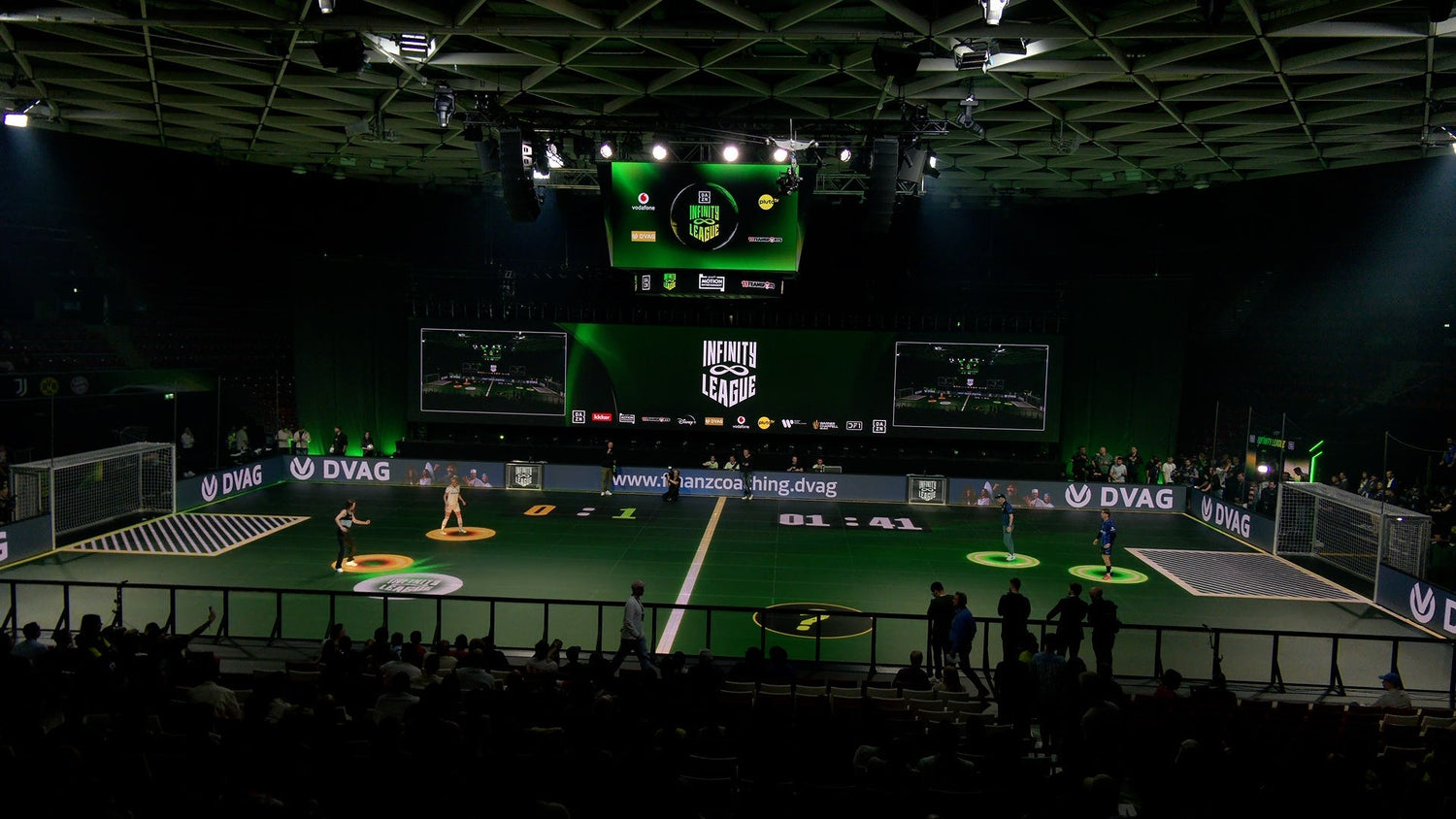
WBLT, a full-service events company based in Germany, has built a reputation for pushing the boundaries of live experiences through its use of technology to empower creative execution. For the second edition of the Infinity League, an entertainment-driven indoor football format launched by sports streaming service DAZN, WBLT managing partner Jochen Graf and his team were brought on board to help introduce new levels of interactivity and immersive qualities to the activation. Central to achieving this was Stage Precision’s SP software, a unifying data and control tool that proved pivotal in real-time tracking, lighting integration, and the deployment of dynamic visual overlays during the exciting event, held at Munich’s BMW Park Stadium.
“Infinity League is DAZN’s attempt to engage a younger audience by blending professional sport with modern entertainment,” explains Graf. “They wanted to differentiate it from the many existing football formats by bringing in elements such as real-time interactive visuals. That’s where our team and bright! studios and became involved.”
The concept for the 2025 Infinity League event revolved around enhancing the viewer experience for live attendees and online audiences by merging game performance data and storytelling. The vision for this was the transformation of the traditional football field into a visual centrepiece with an LED floor, over which custom graphics such as player names and tracking, ball speeds and other live statistics could be shown in real time.
“We had worked with bright! before, particularly at SAP Garden, and they were already operating an SP server at the BMW Park venue for permanent light tracking,” recalls Graf. “When the challenge arose to integrate tracking data with real-time graphics, bright! immediately recommended using SP.”
The production was highly data-driven, relying on Kinexon for player and ball tracking. Over 50 players wore trackers during the event, feeding precise positioning data into SP. This data was then mapped and synchronised across multiple systems, including Unreal Engine for interactive visuals and Pixera for media playout of these visuals. SP acted as the glue between these platforms, enabling data flow and content synchronisation that could keep up with the energetic gameplay. Light tracking and control were also integrated within the SP workflow.
“Everything came together through SP,” says Graf. “We received the tracking data from Kinexon, piped it through SP, and used it to trigger visuals via Pixera and Unreal. It was a complex chain, but SP made it possible to manage that complexity in a clear and structured way.”
For Graf, one of the standout features of SP is its real-time calibration capability. “Just a few hours before the show, we added in some key lighting elements to the production,” he says. “Calibrating those last-minute additions with SP felt almost like magic. It is quick, intuitive and surprisingly easy to learn. As a professional events designer, this kind of tool is a game-changer.”
Beyond just the technical integration, SP opens up unlimited creative potential for future projects. “The whole concept behind SP is visionary,” continues Graf. “We’re only just scratching the surface of what’s possible, especially for interactive sports formats. We already see strong interest from both sports and corporate clients who want to explore this level of interactivity. SP will play a leading role in that evolution. It is not just another tool in a production toolkit; it’s a gateway to innovation.”