
Saudi Arabia, 2024
<!-- text -->
Large-scale visual effects at Esports World Cup with bright!
Eight-week esports tournament requires powerful and scalable control for AR elements and visual effects
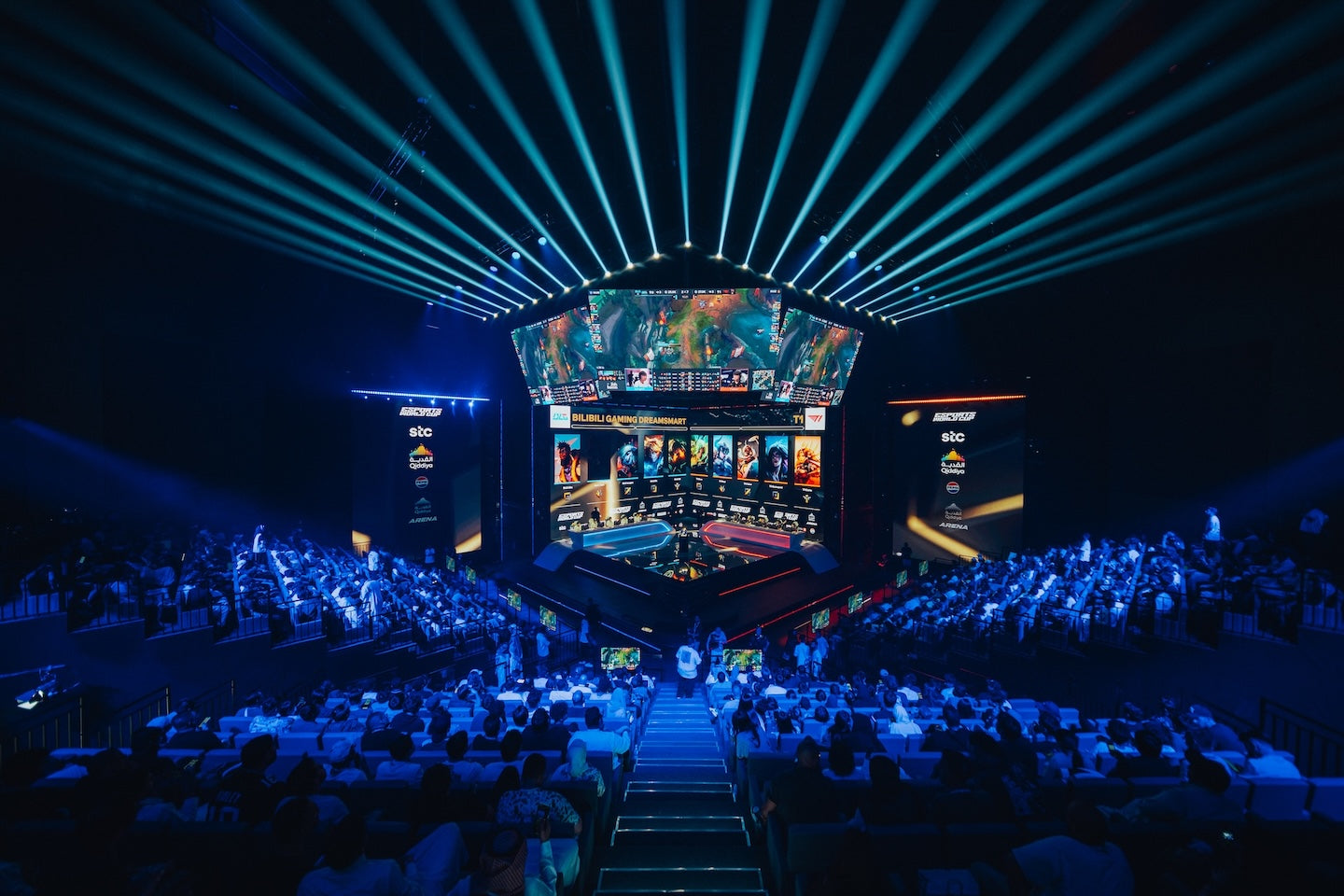
Funded by the Saudi Arabia Public Investment Fund, the 2024 Esports World Cup (EWC) was the first edition of an event that is set to redefine the scope of esports worldwide. Held in Riyadh between July and August, this multi-game tournament was the world’s largest-ever esports event, featuring 23 tournaments across 22 different video game titles, including Honor of Kings, DOTA 2, League of Legends and many more. Replacing the Gamers8 festival, EWC’s numerous tournaments each consisted of its own unique format and rules, with a cross-game competition of The Club Championship running alongside and introducing a new group element to this esports extravaganza. The total prize pool across the entire championship was $60,000,000 USD. Throughout the eight-week championship, virtual production technology specialists, bright! studios, worked to implement show-stopping visual effects to bring both the gamer and audience experience to life.
“Having worked on Gamers8, we were familiar with the requirements for EWC, but the scale of the project was truly impressive,” says Leon Herche. “Our focus was on creating and delivering custom visuals, augmented reality elements and LED graphics for multiple stages across three venues.” Stage Precision’s SP Grid software provided a unified tool for managing the sheer volume of show data and maximising efficiency in technical operations across the site.
Alongside bright! and with the support of the SP team, key stakeholders for the project included Evoke, Bild Studios, Framesync and a team of freelancers, working across six stages and three studios over two months. Viewers of the content would be both in-person gamers and online broadcast viewers.
All stages featured the same LED screens and layout, accommodating seating for gamers plus a stage and giant screen to display real-time game footage and the all-important visual elements bright! were responsible for deploying. “Whilst the stages were similar, each game required its own branded visuals and different effects,” explains Herche. “With SP, we could build one base project, roll this out across all six stages, sync it with the alignment and tracking data of each stage and link it with the game-specific visuals. This saved alot of time, and SP’s custom UI features make it simple for the operators to select and connect the corresponding data sets and content efficiently during show time.”
With the base structure in place for key game milestones such as winning the round or match and other game-specific actions, bright! utilised SP Grid as the central control hub for game data and content triggers. Game data is pulled from the gamer database into the SP Grid workflow, where it is connected with the live gameplay data in order to trigger the media servers to play content of particular game stats or scenarios on the screens or AR streams.
Throughout the EWC, bright! leant on the data management, control and visualisation tools of SP Grid for full media server control, system monitoring and failover. Furthermore, SP Grid’s improved lens calibration tools allowed the teams to pre-calibrate all cameras across the site in advance. “There were some delays on the project, but with the pre-calibration tools, we were ahead of the game,” remarks Herche. “The results are very accurate and make it easy and fast to calibrate multiple cameras. With any other solution, the lack of time would have been a serious issue.”
For any functions that were not already available in SP Grid, the new Python scripting feature meant that the bright! team could create custom scripts to bring to life different game elements, giving the team a truly agnostic toolkit in which to build unique and engaging gameplay concepts. In one such scenario, the team built AR cues to fetch player data from the game, reassemble the data in SP Grid and then connect this data with AR content to show which players were dead or alive in the game by triggering coloured lights on-stage.
With all stages equipped with SP Grid, operators without previous experience with the platform were able to control show content via the action system feature, which allows for simple drag-and-drop functionality
Aside from gameplay content, bright! studios also implemented the SP Grid platform for control and management of LED screen content during the impressive opening and closing ceremonies of the tournament. “For the opening ceremony, there was a light show, so the timing of the LED content was crucial,” explains Herche. “To ensure perfect timing, we set up an instance in SP connected to the media server where we could convert timecode to a keypress to trigger the media servers at exactly the right time. This is a typical illustration of the impressive versatility of SP — any AV issue that comes up, SP has a fix or a workaround.”
The eight-week event captivated fans of video gaming across the globe and has set high expectations for the championship’s return in 2025. For bright!, the complexity and scale of the project could not have been effectively handled without the trusted toolkit found with SP Grid. “From the camera calibration to the custom UIs and action system features, SP has been critical to the success of our work on EWC,” confirms Herche. “No other software could have handled the sheer volume of data involved in this project.”