
Sweden, 2024
<!-- text -->
SP unifies technical departments at the Eurovision Song Contest 2024
The Eurovision Song Contest is undoubtedly a touchstone in the global entertainment calendar. There’s no doubt that with every passing year, the production grows in complexity and scale. This year’s contest in Malmö, Sweden, brought together 37 acts from across Europe and beyond, alongside a vast team of technical production specialists, tasked with pulling off one of the most technically demanding and fast-paced events in the cultural calendar. Hans Cromheecke, who has more than 30 years of experience in production technology and is known in the industry as the ‘AV Wizard’, led the video part of the production.
“I was responsible for everything related to screens during the production,” recalls Cromheecke. “From media servers to what was shown on the screens, it was my responsibility as Head of Video to ensure everything worked as it should.”
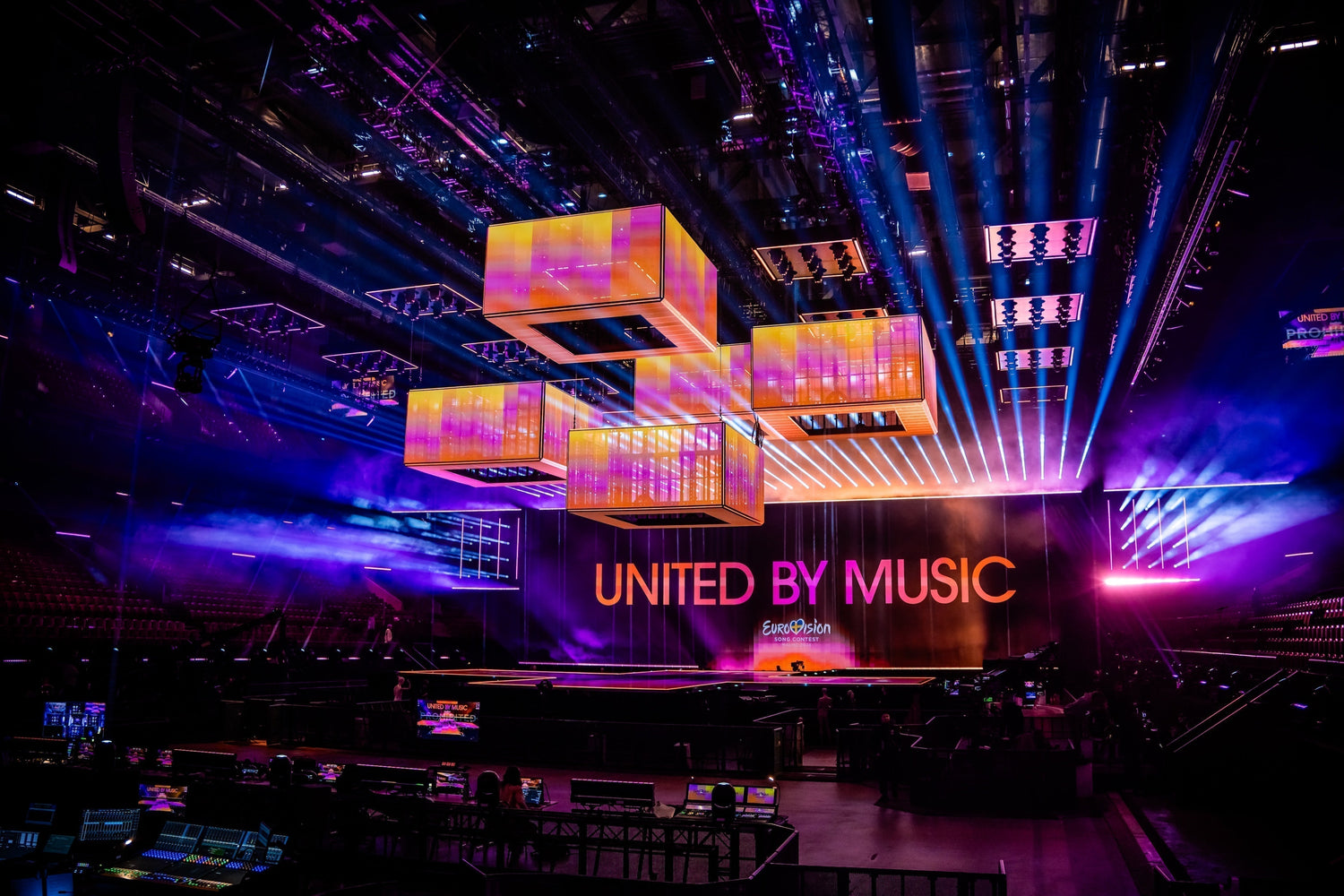
The stage, positioned in the centre of the arena, was equipped with LED back walls and five moving LED cubes hung above the stage. Whilst these were the focus points of the video needs for the production, there was also a comprehensive system of overhead lighting and follow-spots along with complex automations, including pyrotechnics, to control. Official Technical Events Supplier, Disguise, collaborated with Official Events Supplier, Creative Technologies to design a full SMPTE ST 2110 workflow between the media servers and the LED screens.
“There were a lot of moving parts to this production, both from a video perspective and in terms of automation,” explains Cromheecke. “Everything needed to work together in unison and with complete accuracy.”
During preparations for the live event, it became clear that the data between the LED cubes and the lighting desks was not 100% accurate. Diagnosing the issue quickly and efficiently was critical for the smooth running of the show. “I suspected a protocol issue due to the naming of the two lighting automation desks, but I needed a way to prove this and to fix this,” explains Cromheecke. “So, I got a license for SP by Stage Precision to visualise the data and find a way forward.”
Having been an advocate of the datalinking capabilities of SP since first using it on a live production in 2020, Cromheecke got to work setting up a simple input and output for every connection on the Eurovision production. Follow-Me light tracking sent the data back into SP which could then split the data and send it back out to the lighting and video desks. By unifying all the tracking data for the show into SP, all the moving elements could be visualised together and the production team could easily identify if something was out of sync or at risk of error.
“Every movable object on the stage generated a set of live positional data that was collected in SP and then distributed, handled and adjusted to fit the needs of whoever is receiving that data,” continues Cromheecke. “In a situation like Eurovision when we are working on a network, data is essential. You want to be able to see it and use it.”
With the entire Eurovision video, lighting and automation unified in SP, Cromheecke began to think about how a tool like Stage Precision could act as a crucial common denominator on increasingly more complex productions. Even on the largest productions, there is no single person to own the role of bringing together separate departments and their technologies. Cromheecke believes that having a dedicated person managing a system like SP would be the next realistic step in the evolution of live events.
“With the rise of IP networking workflows, where data needs extra attention and care, having a dedicated person managing a tool like SP could be a gamechanger,” reflects Cromheecke. “Not only would this connect separate departments, but it would also bring an extra layer of reliability and predictability on large-scale productions where we need it most.”
On the set of Eurovision, the technical team were pleased with the problem-solving capabilities of SP. Still, Cromheecke believes that as the awareness of this tool expands, it will become a mainstay of event production, providing the necessary visual awareness required by many different departments and at varying levels.
“Technology manufacturers often claim their software has similar functionalities, but anyone that works in large event production will know that the data in this software is so often siloed, with no integration between different hardware types or brands,” says Cromheecke. “SP is not just a software doing funky stuff, it’s a critical linking tool that also allows us to manipulate the data in real-time, giving users the power to solve problems on the fly. It is relevant to any big production involving automation.”
What will this new connected world of event production look like? When various technologies are working together, it’s essential that they can also be visualised and monitored in a unified way. Whilst the use of Stage Precision software on the Eurovision project was reactive, making the proactive choice to assign a dedicated ‘integrations’ specialist to act as a unifying agent between departments would result in a smoother overall production experience for all.
“There’s no alternative really; SP is a full solution,” concludes Cromheecke. “I will fight to ensure this tool is a necessary component of any big production I’m involved in, but the events technology community needs to consider how creating a dedicated front-of-house role for this purpose could revolutionise the production process entirely.”