
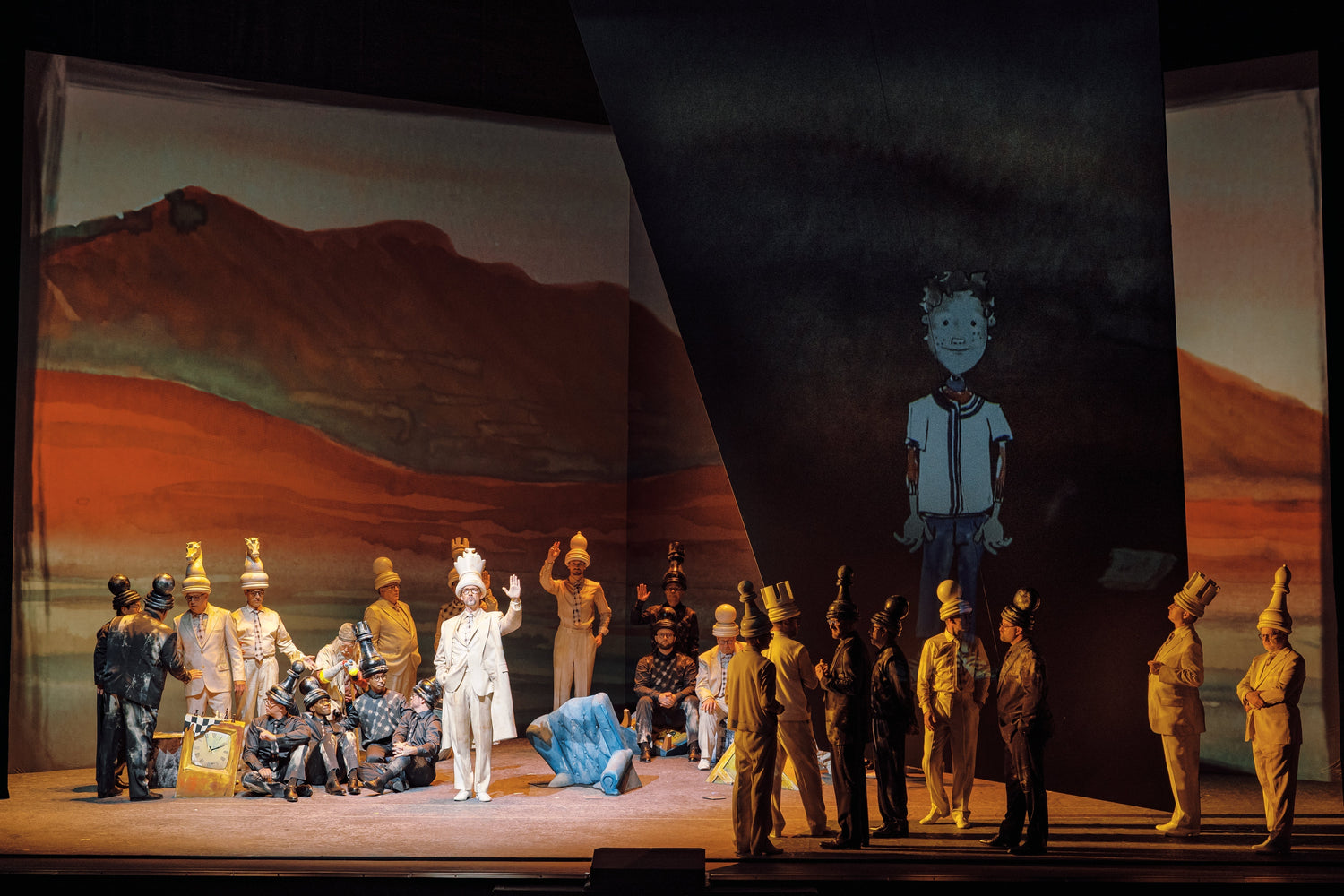
Vienna, Austria // 2026 - Photo Credits © Volksoper/Marco Sommer
SP software empowers Volksoper to transform stage design, offering flexibility and enhancing storytelling
Austrian opera house, Volksoper Wien, is one of Vienna’s most sophisticated venues for musical entertainment. Hosting some thirty productions throughout its annual season, the theatre is renowned for its exceptional opera, operetta, musicals, and ballet performances. The 2025/2026 program features Mozart’s opera, The Magic Flute – the classic tale of the prince on a quest to rescue a princess. While the story may be a familiar one, Volksoper’s immersive production offers a fresh experience.
From the minds of artistic director Lotte de Beer, The Magic Flute blends traditional storytelling with innovative technology, using video projection to create an array of fantastical settings. Requiring precise projection mapping and real-time tracking, Stage Precision’s SP software proved to be the essential tool that brought the opera to life. Typically, theatres rely on handcrafted set pieces carried onto the stage throughout the performance by cast and crew, each one unique to the specific production and scene. While there is beauty in this tradition, it is a time consuming practice for a venue staging some thirty different productions per year. “For The Magic Flute, the idea was to design the backbone of the set with projections,” says Christian Allabauer, head of Volksoper’s lighting and network technology team. “This would allow us to move through the story, transitioning between scenes and settings almost immediately and with minimal intervention from the crew.”
During a previous production at Volksoper, a similar approach was attempted, using a single projection surface to cover the entire stage. “While the result was adequate, we aimed for a more flexible and intricate front projection for The Magic Flute, one that would rely on the interaction between projections and stage machinery,” Allabauer explains. Rather than a single surface, six individually moving projection screens were deployed, fitting together like puzzle pieces.

“All differing in shape and size, the projection screens must move together in perfect synchronisation in front of an eager audience of 1,300 people,” he states. “The challenge here was ensuring that the video content would align with the moving surfaces without slipping or hitting the back of the stage. We could not allow for any mistakes that might take the audience away from the immersive performance.”

The accurate scaling of the projection surfaces required the detailed mapping and tracking capabilities of SP. Having attended an SP training session the year prior, Christian Allabauer was already well-acquainted with its advanced feature set. To find a solution that was the right fit for this production, the Volksoper team consulted with local theatres, who strongly recommended SP.
“We benefited greatly from the expertise of Stage Precision’s service team, who proved to be an essential asset during the early stages of the project,” Allabauer recollects. “They helped us establish the foundations of the system, which relied on the relationships between stage machinery, positioning data, and projections.”
Three ETC EOS APEX lighting consoles serve as the venue’s central control platform, from which the lighting and multimedia teams manage all lighting, and visual elements, selecting which content should be played and when. Once SP was integrated into this workflow, it became the core of the entire motion tracking system, enabling all content and positioning data to be tracked and managed efficiently.
The secret to SP’s tracking capabilities lies in its advanced tracking and mapping features. “To accurately synchronise video content with the projection surfaces, we need to have complete visibility at all times,” reveals Allabauer. “Individual scaling and full control of any single parameter, that’s where SP excels compared to other platforms; we can map and build the entire AVLM (audio, visual, lighting, and media) system without limitations in a single control interface, taking into account the real-world environment and adjusting parameters to ensure we have an accurate target for the projections.”
Already part of the stage machinery, sensors attached to flybars – from which the projection surfaces hang – transmit their real-time position to SP using the PosiStageNet (PSN) protocol. “Within SP the positioning data is tracked and merged with the lighting control data, then forwarded to the media servers, which manage the content and send the video signal to the projectors,” continues Allabauer. “Due to the large scale of the system, some delays were to be expected. Thanks to SP’s filtering abilities, the prediction filter allowed us to compensate for system latency and gave the required accuracy to make the magic work.”
Designed by an external content creation team, the video content was inspired by the drawings of Volksoper’s resident set designer. “In our interpretation of The Magic Flute, the story unfolds within the sketch book of a thirteen year old boy,” describes Christof Hetzer, who developed the artwork and set design for the production. “We imagine that he uses pens and brushes to create a fantasy-world. We thought it would be really magical if the audience could not only dive into the sketchbook at the beginning of the story, but also witness how the ideas of the imagined artist turn into moving characters who interact with evolving landscapes that materialise before their eyes.”

The careful combination of vivid colours and animated sketches transport audiences into this fairytale-like world. Kinetic video projections allowed the team to develop a production that celebrates the craft of storytelling while eliminating many of the technical roadblocks that come with conventional stage design – and SP was the root of this success.
The in-house lighting and multimedia team is stationed at the lighting desk to manage the AVLM elements each night. “My role now is to oversee the tracking feature, which is critical for the flawless execution of the entire production,” says Allabauer. “With SP at the heart of the system, we can ensure that the video and projection surfaces move in perfect unison, giving us full control over the performance. It has proven to be an indispensable tool for realising this unique artistic vision.”
While the initial setup took longer than a traditional production due to the technical innovations, Allabauer and the Volksoper crew have since become well-versed in the management of the system. “Without the need for heavy, large-scale props and set pieces to be carried onto the stage, we can run the show smoothly with minimal intervention. The actors can focus on delivering their performance, the crew can manage the scene changes discreetly from off-stage, and the audience remains fully immersed in the experience. The audience is often unaware of the complexity behind the interactions they witness, as they are fully engrossed in the world we have created.” Lighting designer Alex Brok illustrates, “In the field of lighting design, the integration of motion tracking can be a key factor in the conceptualisation of designs that utilise video, with the objective of achieving movement in accordance with the dynamics of the scene”.
“As a video artist, the creative vision is only as good as the technology that ultimately brings it to the stage,” comments content designer, Roman Hansi. “Mapping six moving screens with centimetre-precision is a massive undertaking – and honestly, without Stage Precision, this production wouldn’t have been technically feasible. It’s impressive to see how SP bridges the gap. The prediction filters, in particular, were the key to compensating for the natural inertia of the system with multiple layers so that the content doesn’t lag behind. It always sounds so easy in theory, but there is so much meticulous fine-tuning that goes into a setup like this, and SP helped us cover all bases.”
Since the integration of SP at Volksoper, other productions have requested to experiment with SP’s unified AVLM and sensor tracking workflows to transform the stage into a range of dynamic and imaginative settings. With the infrastructure already in place, Volksoper Wien has the flexibility to scale up or down, changing only the video content and the movement of the projection to create entirely new productions. “With this approach we have not only simplified the set design, but we have developed a powerful storytelling tool that ignites the curiosity of audiences,” Allabauer concludes. “Whether it’s opera, ballet, or musical, with SP we can enrich every performance, weaving classic storytelling with forward-thinking technology.”
Photo Credit: © Marco Sommer