
Germany // 2026
User story: bright! studios unlock new levels of experience creation and creativity with SP Grid
bright! studios are at the leading edge of experience creation. The full-service creative studio specialises in bringing brand experiences, interactive spaces and live productions to life through technology. Having been an early adopter of SP in their workflows, bright! was among the first to utilise the full capabilities of the new SP Grid during its initial beta release. “We’ve been using Stage Precision’s tools for years, on a huge variety of activations, and, for us, the new feature set of SP Grid has proven pivotal for introducing more complex elements to a wider range of environments,” says Patrick Lenkeit, Technical Director at bright!
Since joining the SP Grid beta, bright! studios have put the platform through its paces across a range of demanding, multi-layered projects, from immersive dining experiences at Eatrenalin, to crafting unique brand environments in collaboration with The Storytelling Company. SP Grid’s custom UI capabilities and deep hardware and media integration have proven to be the biggest game-changers.
“For us, SP Grid really shines when you’re juggling a lot of different systems, from media playback and audio to sensors and automation,” explains Lenkeit. “What used to require multiple control layers can now be brought into one environment, with one user interface.”
In several recent installations, SP Grid sits at the heart of both device control and user interaction. Lenkeit describes how this plays out in projects like Eatrenalin, the ‘world’s most exciting gastronomic experience’. “The dining platform moves guests through the restaurant on a timed schedule. The media, lighting and audio are automated. The restaurant staff only need to hit one switch, and SP Grid takes care of the AVL experience and everything behind the scenes,” he says.
Additionally, the ability to create custom UIs has been pivotal. SP Grid allows bright! to design intuitive, branded interfaces tailored to non-technical users, whilst still giving full control access to technical teams when needed.
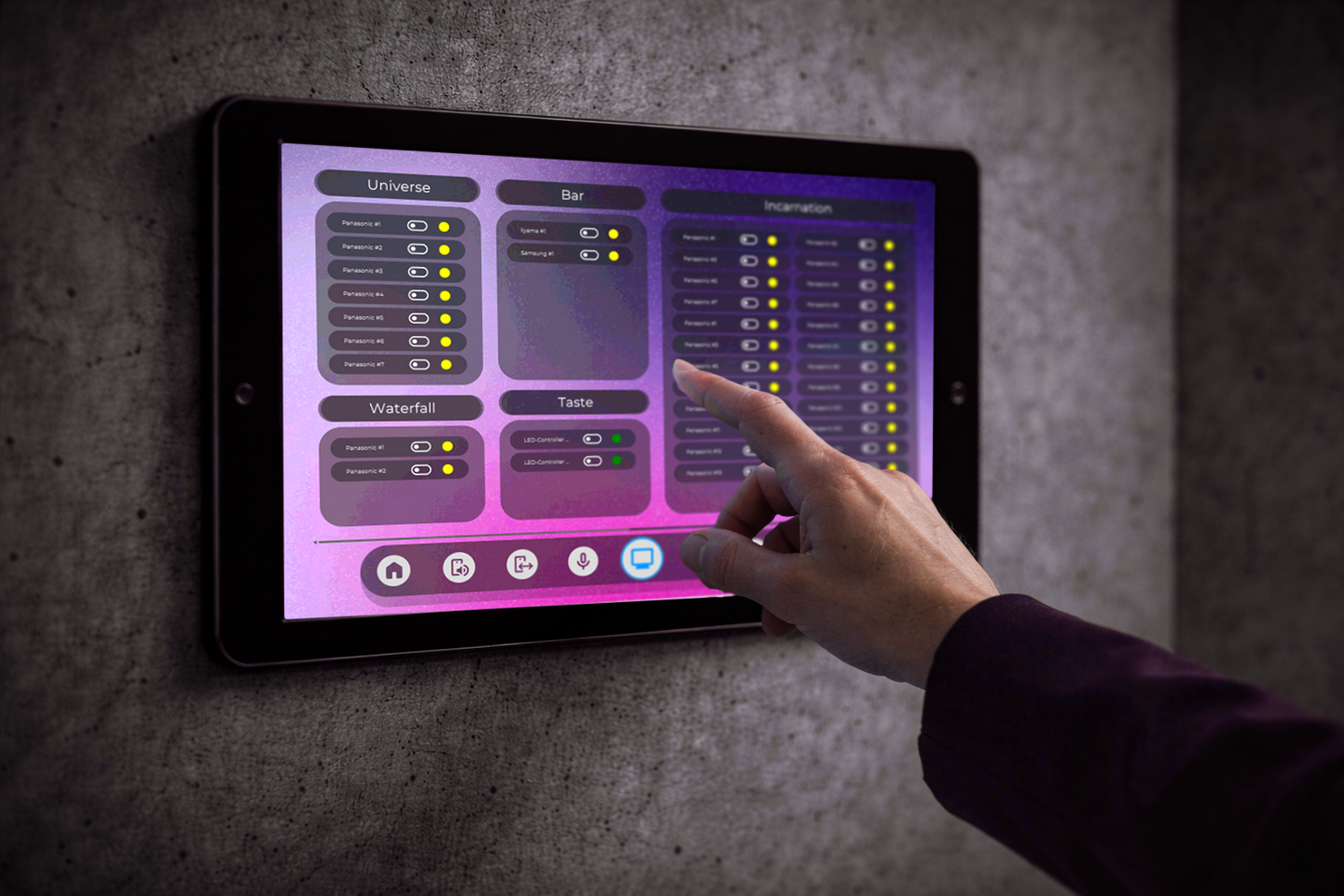
“At Eatrenalin, there’s a small SP tablet behind the bar and another at reception,” continues Lenkeit. “Each one runs its own branded UI with just the controls relevant to that area, but there’s also a hidden menu where you can access more system controls. It’s clean, intuitive, and all built within SP Grid.”
Many of bright!’s projects also involve sensor-driven interactions, things that would traditionally be managed by a separate control system. SP Grid changes that.
“Normally, you’d have one system for control and another for the sensors or point of interaction,” explains Lenkeit. “With SP Grid, you can combine both. If a room is in a certain state, the system can automatically block specific sensor inputs or trigger different media servers. That kind of flexibility is huge.”
One of the most significant developments in SP Grid’s evolution has been the introduction of Python scripting. “The switch to Python has made a massive difference,” says Lenkeit. “It’s a full scripting integration, so we can now use libraries, automate more complex logic and customise SP Grid even further to suit any project. It’s turned SP Grid into a proper development platform, not just a control tool.”
SP’s new hardware line, including GRID Touch touch panels have also played an important role in bright!’s recent deployments. “We’ve mostly been using the tablets so far,” says Lenkeit. “They come in different sizes and are PoE capable. You just connect them straight to SP Grid and display your custom UIs on the screens. The hardware and software are talking to each other perfectly, straight out of the box.” This level of integration gives bright! a unified workflow from design to deployment, ensuring that even complex installations can be made to feel approachable for the end user.
Another key benefit Lenkeit highlights is the new flexible licensing model. “SP Grid scales with your project,” he states. “You can start small and add credits as the project grows in complexity. It’s great for working with different client budgets, and it means we can use SP Grid on smaller, more experimental projects too.”
bright!’s team can now focus on mastering one toolset across all project types, from experiential pop-up activations to permanently installed environments. bright!’s recent work with The Storytelling Company (TSC) demonstrates this versatility. “We’ve deployed SP Grid across five different projects with TSC,” Lenkeit shares. “These include brand experiences, company showrooms and some very sophisticated conference rooms. We used SP Grid to create scalable workflows for all of these environments.”
As SP continues to develop new features, bright! studios is eager to explore what’s next. “We’re really looking forward to the new workflows feature,” confirms Lenkeit. “With SP Grid, once you’ve invested the time in learning the platform, you end up with a super flexible, super capable system that can adapt to almost any project. It opens up so many new possibilities.”